Tuesday, October 2, 2007

the low point

Pat in healthier times, rowing a boat at Indira Gahndi Park in Hyderabad

Pat had come home from school Saturday afternoon looking pale, and asked for some Tylenol. That was when I knew I was in trouble. If my husband asks for Tylenol it's got to be pretty bad. He perked up briefly before his fever spiked dramatically and kept rising - even after a second dose of Tylenol. When his temperature reached 104 sometime after 11pm, I decided it was time to take action. I called Sudha and asked her to take us to the hospital. Ten minutes later a posse of neighbors arrived to assess the situation. I know they all meant well, but they did not believe that Pat could be that bad off. "Just a little fever." They said. When I protested that he was in serious shape, they wanted to retake his temperature, and have him "just take rest". I finally had to put my foot down. "No! " I commanded, trying to keep the edge out of my voice. "He is getting worse by the minute, he needs to see a doctor!" After some further consulting we finally set out for the nearest hospital.

The streets were amazingly quiet, even the cows had called it a night. It was such a contrast from the congestion of the daylight hours. The hospital too was quiet at this hour. Unlike Emergency Rooms in the US, we walked in the door, greeted the doctor and got down to business. No paperwork, no triage, no waiting. Pat, burning with fever, was pointed toward a gurney in the corner. As he went to lay down on the stained sheet he disturbed a large moth that fluttered up and resumed it's rest on the splash stained wall. My confidence started to plummet as my stress level rose. Oh God, how did I get here? I would have given anything for a sheet of that annoying crinkly paper for Pat to lie on.

Vitals were taken and discussion commenced about food borne illness. I was starting to percolate with anxiety. The doctor hadn't even examined Pat but had already made his diagnosis?!?! "Is there any chance this could be meningitis?" I pleaded "Or a mosquito borne virus?" I just couldn't accept this diagnosis so quickly. After all we had eaten almost all the same foods and we drink the same water.

"No." The doctor said flatly. "No chance, Madam. He is exhibiting all of the classic symptoms of water and food borne illness. This is very common here." Our helpful neighbors who accompanied us to the ER seemed confused by my inquiry, they, after all thought he had just a little fever. The doctor explained that, unlike in India, in the US a fever like Pat's is uncommon, and meningitis is always a suspect.

Pat got a shot to reduce the fever and a shot of antibiotics, as well as an IV to restore fluids. As I sat with him we quietly laughed at the absurdity of our situation. It's 1:00am. We are in India in a reputable hospital Emergency Room lying on a stained sheet in the corner of a cluttered room. Our doctor is gently mocking our worry, and chuckling that we do not know illness like the Indians. The moth, still present, flutters by to perch on the broken venetian blinds. We are a long way from home.

Despite my initial lack of trust, our doctor is very competent and quite friendly. As it turns out, he had spent time in the US so he understood our anxiety as well as our expectations. Once things had settled down a bit he said: "I like your country very much, but the food is not good. You cannot even get a good masala." Indians are proud of their cuisine, and rightfully so. I had to agree with the good doctor, a good masala is hard to come by.

While Pat rested with his IV, I was instructed to go to the 2nd floor Pharmacy to replace the medicines that had been administered (I brought new drugs and needles back down in a bag to be shelved). While I was gone Pat overheard the nurse comment on how big Eli was. To which the doctor replied: "That is their race." Which gave us a good laugh.

Two hours later we were headed home. Pat, while still very ill, was improving. My anxiety was ebbing - and exhaustion was setting in. By morning the fever broke, but Pat, still weak spent the day in bed, finally emerging at dinner time to check his email. As exhausted as I was, I was also hugely relieved. While I wouldn't have wished this on my worst enemy - I was grateful that it was Pat and not one of the children who suffered this fate.

Monday, October 1, 2007

Queen for a day

For my birthday on Friday Sudha helped me into my first saree. The saree had been presented to me as a gift at the marriage we attended last month - I was very excited and pleasantly surprised to receive it. Sudha took me to the tailor to have the blouse custom made, helped me acquire a petticoat and stitched the hem for me. As one final and meaningful gift she came over and taught me how to put the thing on. It's not terribly complicated, but will require practice. Once the saree was on I did not feel as awkward as I thought I would. As a matter of fact I felt very elegant. I actually felt as though I should be headed to a black tie affair and not preparing dinner and chasing my children around the house. Women wear the saree all the way to the floor, which I think adds to the beauty, but because of this I had to walk a little straighter to keep from tripping on myself. And when you walk a little straighter, you stand a little taller. And when you stand a little taller you actually feel a little better about yourself. The old metaphorical mind-body connection. You can't slouch (like I do ALL the time) and still be beautiful. I think maybe I am slowly starting to unravel the beauty secrets of Indian women.

It is my humble opinion that Indian women, regardless of status, age or wealth carry themselves with incredible grace, elegance and beauty. Even the woman who cleans our house, and who happens to live in tarpaulin tent, looks like she just stepped out of a magazine. For starters, woman always wear their hair in a single braid down then back - no sloppy ponytails, no loose buns, and never down, which is considered immodest. A vast majority of women wear sarees (local spelling) and the rest wear salwar kameez - an elegant, colorful pant and tunic always accompanied by a long scarf. Married woman must never be seen publicly without the tikka (the red dot) on the forehead, bangles on each arm, and toe rings on each foot. I love these small touches of adornment and find they are like the icing on the cake. American culture places such an emphasis on sex appeal. But here the emphasis is on modesty and simple beauty. As a result, I think the beauty of the women in India is unparalleled.

Even at home women wear what they call a "nightie" which is definitely not the type of nightie that I know you are thinking of. A nightie in India is a short-sleeved, floor length, cotton house dress. As is the case with all Indian textiles most nighties are dyed and printed in exquisite designs and colors. I am now the proud owner of two of these house dresses - and I love them! My downstairs neighbor, a young, newlywed named Laxmi, came to visit the other day while I was wearing my nightie, and told me I looked "very, very beautiful - much better than in the pant-shirt". I happily accepted this backhanded compliment because I actually agree. I feel very awkward in my pants and tee-shirts while everyone around me looks so elegant. Being tall, white and blond I stand out enough - but add in a pair of pants and a tee-shirt and I feel like I'm wearing sweatpants at the prom.
To remedy my self consciousness I have acquired some toe rings and bangles. I have also been slowly amassing a new wardrobe of Indian textiles, that, while very beautiful and modest, are not necessarily what local women are wearing -but are far more beautiful than my Target clearance rack pants and shirts. My saree wearing days are not over, however, my frumpy, crunchy granola look just maybe on the way out.

Friday, September 28, 2007

Head Wobbling

Each culture has gestures, slang and body language that is unique unto itself. What’s fun as a traveler is watching and learning not just the big picture of a culture – but also these little minutia that permeate daily life. My favorite example of this is what we refer to as the "head wobble". How to describe the head wobble…? I fear this is no easy task.

It is not a nod, in the traditional chin to chest “yes” gesture that we know. Nor is it a chin to shoulder “no” gesture. It is, if you will, a cross between the two – more of an ear to shoulder type of nod. The irony of this gesture is that while it looks like a perfect love child of yes and no, it’s meaning is multi faceted and wholly dependent on mood, circumstance, and perhaps weather. The head wobble, can mean: “Yes!”; it can mean “No”; it can mean “Maybe”; it can mean “I don’t know”; it can mean “You’re welcome”; it can mean “I hear you”; or “I understand” or even “Yes, I hear you, but I don’t understand, and therefore I’ll just wobble at you and hope you’ll move on.” The latter being my least favorite meaning, as it is hard to know that this is the implication.

As disciples of a definitive Yes/No culture it can be enormously frustrating to try and decipher the meaning of the head wobble. After some nervous trial by fire I came to realize that the wobble of the auto drivers is the easiest to read, but not perhaps the best to study.

Me: “Venkatapuram?” (This, by the way, is the name of our neighborhood. If we have an actual address I couldn’t tell you what it is. Nor am I certain that our street even has an actual name. But I digress…)

Auto Driver: Head Wobble. Pause. Speeds away without a word.

This is a strong indication of the negative. Either, “I don’t understand your ridiculous accent.” Or “No, I will not take you there.” Either way, I get the picture. By contrast the affirmative, usually goes like this:

Me: “Venkatapuram?”

Auto Driver: Head Wobble. Pause. Then he switches on the meter. The pause can seem like forever sometimes, especially in a monsoon.

The other random miscue we have noticed is the use of the word “OK”. Indians use “OK” quite a bit. Even those with very limited English know and use “OK”. Here, in India, it is very much an affirmative word. You would not use it, for example, to explain mediocrity, as in: “The soup is just OK.” There is no subtlety or multiple meanings. OK is good, or yes, period. When we eat out and the waiter comes to ask if we would like anything else Pat and I used to be in the habit of saying: “I think we’re OK.” In response to this the waiter would typically give us a look of perplexity just before wobbling his head, leaving, and returning with a menu. Or less complicated, might be: “More coffee sir?”. To which Pat replies, “I’m OK.” At which time the waiter head wobbles, and pours more coffee into his cup. I’m not sure if it's just Pat and I who do this, or if it's an American trend, but I suddenly realize how ambiguous we sound. We are trying to reform ourselves, but old habits die hard. And here I thought Indian head wobbling was odd… Since it's near impossible to photograph the head wobble, I have included some of my favorite recent pictures. In the top picture are my favorite head wobblers - Dr. Sharma's 2 girls and a neighborhood boy. The bottom picture is from the festival of Ganesh... more on that later!

Thursday, September 13, 2007

Tying the Knot day 2

Since it seems I forgot to mention who was getting married in my previous blog - some background: Dr. Sharma is our exchange partner who is currently living in our home in NH and teaching at Pat's school. Sudha is his amazing, out-of-this-world wife who has stayed here in India with their two beautiful daughters - Verajita, 13 and Vipanchika, 7. Sudha and the girls have been taking remarkable care of us throughout our journey thus far, and the marriage adventure was no exception. The marriage was between Dr. Sharma's nephew and a young woman from this village of Miryalaguda where we have traveled. Both bride and groom are young and well educated, she is a mechanical engineer and he is a software engineer. This is an arranged marriage, as is still very much the custom here in India. I have been told as many as 75% of marriages in India today are arranged, and this is down considerably from only a decade ago. Although, we have never met the bride or groom, we have never felt more welcome and we are treated as honored guests.

The second day of the marriage proved to be just as colorful, spectacular, and hot as the first. It all began, of course, with breakfast. Delightful South Indian breakfast foods with sweetened coffee served up with the insistent pleas of our hosts that we were not eating enough (although I felt like I gained 5 pounds in those 2 days). While the puja began sometime around 11, the atmosphere remained social and relaxed despite the seeming intensity of the offerings and Sanskrit prayers. Patrick and I spent the morning socializing with our respected sexes, as there is a social order here that seems to frown upon mingling with the opposite sex without a husband present. I enjoyed very much talking with some of the young women I met, who were very well educated and all very eager to practice their English. Some of the older women spoke less English but with a baby and some sign language we all understood each other.

In the course of all this I was offered a henna tattoo or mahindi on my hand. (My secret wish come true!) For the next hour my newest friend, a cousin of the groom, labored with painstaking detail on my hand. I, however, got to sit back and relax, my children cared for, and listen to the Sanskrit chanting as my hand was hennaed. After the design was complete I could not use my hand for another full hour, which naturally got to be difficult given the fussy baby factor. The fussy baby, taking a page from Murphy’s Law, only fusses when mother: a) is about to eat b) is trying to nap c) has her hands full – or in this case damp with henna. With some help from a dozen random women, Eli was walked, bounced and cooed at for most of that time. When he was finally inconsolable I took him in my left arm and paced him and my arm to sleep.
Evan was, as usual in India, the center of all the children’s attention. He doesn’t necessarily like being the center of attention, but he does enjoy having lots of children around to play with. Between games of tag, Evan spent some alone time arranging the plastic chairs in the function hall end to end in a straight line 15 deep. His focus and stubborn determination had half the room giggling and snapping cell phone photos.

The puja continued through the afternoon, but we returned to the air-conditioned oasis of the hotel for a few hours of rest. At the appointed hour we returned to the function hall for the evening festivities, starting, of course, with tea and a snack.
The function hall seemed even hotter in the evening. But we were ushered to the front in range of some very powerful fans. There was a pergola of fresh flowers and palm frowns set on a stage where the wedding party sat with their respected families. The band was playing. All of the women tonight wore saris of exquisite silk – I was feeling a tad under dressed in my cotton kameez (tunic), but even if I had been wearing the finest silk I think I still would have felt like an ugly duckling in this crowd of colorful silk swans.

The puja began around 7:30 pm with some traditional rituals, including the bride’s parents washing the groom’s feet, an exchange of intricately carved coconuts, offerings of food and blessings. After sometime the bride emerged in a large basket carried by her uncles. She was stunning. Outside of the buttery rich silk sari, jasmine, marigolds and roses cascaded down her braid like a waterfall – easily several pounds of flowers. She had two-dozen bangles on each arm, and intricate mahindi designs reaching each elbow. She truly did look like a Hindu princess – at once exotic, elegant, extravagant and beautiful. After 2 more hours of colorful, sometimes playful, often serious puja, at last the groom tied a knot around the bride’s neck - signifying the official joining of husband and wife (kind of like kissing the bride, only there is no public kissing in Hindu culture). It was lovely. As we went down for another decadent dinner I vaguely recall thinking to myself that a day’s worth of puja followed by a 2 and half hour ceremony was quite an undertaking for a young couple. Little did I know there were still seven, yes, SEVEN hours to go!I’d like to be able to tell you more about the evening’s pageantry and puja, but by the time we had finished feasting it was 11pm and the boys were tired. So we retired to the “luggage room” (since we had all checked out of the hotel, everyone’s luggage was stored in this space). There was one king size bed in the room and it was covered with kids. I claimed the foot of the bed and laid down with Eli, Pat and Evan took the head between us were 4 kids and a Grandmother simultaneously playing and resting. We spent the next several hours dozing on and off as best we could –it was a school night after all. Until 4am when the bride and groom emerged looking faint but happy for one final blessing and the offering of a sweet – the laddu. Bleary eyed, tired and overwhelmed we boarded the bus for home at 4:30. Despite the long, late night it was well worth the journey. A once in a lifetime experience punctuated by heat and feast; silks and jasmine.

Wednesday, September 12, 2007

Tying the Knot day 1

The bride with her father and mother. The Brahman, or priest is in the foreground

You know it is hot when a South Indian tells you it's hot. And that's just how hot it was on Saturday when we boarded the chartered bus that would take us to our first Indian marriage.

We left our apartment at noon and hurried by auto into Hyderabad proper to catch the aforementioned bus. It was a bumpy, gritty, teeth clenching, 45 minute ride, but I was relieved we had made it with time to spare. We were whisked into the home of the groom's uncle and immediately served with a plate of food and a hot cup of tea.

Finally at 4pm (1.5 hours behind schedule - or right on time in India) we were rushed to the bus which would carry us along with the entire groom's family to the wedding. Part of the delay involved the blessing of the bus, which was adorned in marigold garlands, and a ceremonial coconut - I did not get an opportunity to ask about the coconut.
"Please Sir, please Madame it is beginning to rain." On to the bus we rushed as the afternoon monsoon began. A little rain (even monsoon rain) never bothered anyone... but the bus was not air conditioned and the windows were our only source of fresh air. As we sat waiting for the bus to load you can imagine how quickly it became very, very hot. As if the stifling heat were not enough, some of the windows began to leak copious amounts of water onto our seats. The combination of the human heat, the muggy air and the lack of air movement was nearly intolerable. Finally, finally after more delays 45 minutes after we boarded, the bus began to move. Once moving the air from the windows made the temperature tolerable, albeit sticky.

After 3 hours we reached our destination, a village called Miryalaguda located about 150 km south of Hyderabad. After a quick shower to remove the road grime we headed to the function hall for the evenings festivities, it was 9 pm and hot. The kind of arresting unbearable heat you get on a still bus with no a/c, only this time we were in open air...

However, the uncomfortable heat temporarily took a backseat to the sensory feast happening around us. Like all things in India this celebration was a display of sights, sounds , smells and tastes unlike any other I had experienced. The music, the intoxicating scent of Jasmine hanging heavily in the air, the heat - I truly felt like I had been transported to a different place in time and space.

The bride's family greeted our bus and adorned each of us with a tikka - the red dot - on the forehead. Each of us, except Evan - he wanted no part of anyone touching him. A 5 piece band - consisting of 2 different drums, a couple of very unique reeded horns, and some sort of squeeze box that resembled a large black book opening and closing - played the traditional wedding music as we walked from the bus to the hall.

The men and women were adorned in beautiful traditional dress. The women wore richly brocaded saris of every imaginable color, almost all of them in silk. They all wore jasmine flowers in their hair, and their finest gold jewelry. The men of the wedding party wore traditional dhotis of rich white silk.
The puja, or prayers and ritual commenced immediately in a small, un-air conditioned room on the second floor of the building. We were brought to the the front and given seats of honor. The bride's father greeted us happily telling us in broken English how honored he was to have us present at his daughter's marriage. The evening's ritual was loud, jostling, and playful, lasting almost 2 hours. The bride and groom each surrounded by their respective families slowly and playfully walked toward each other, hoping to meet in the middle. If they met too far onto the groom's side, this would mean the bride would be too dominate, too far on the bride's side the opposite would be true. The idea, of course, was to meet in the middle to achieve a balance in the marriage. With the families pushing and pulling it became a playful act lasting for quite some time. And did I mention the heat? It enveloped us in it's unwelcome embrace all evening. Despite the heat and noise Eli fell fast asleep - sweating and sticking to me. Evan, tired, drenched in sweat and overwhelmed eventually found some children to play with, and given the circumstances was relatively well behaved.

Following the puja there was a traditional South Indian feast - rich, spicy, and finally, delectably sweet. By the time we finished dinner it was midnight. At the conclusion of day 1 we knew Sunday would be a long day, we just could not have known how long it would turn out to be...

Thursday, September 6, 2007

Evan the Terrible


Evan has had to make the biggest adjustment to living in India, and it has not always been easy. For starters, there is no TiVo, no playgrounds, he has only a limited amount of toys, and to top it all off there are people everywhere that want to touch him. As we meet people, he has, at times, been down right awful - throwing himself on to the ground, running away screaming, or yelling loudly whenever someone tries to speak to him. On several occasions it has been really embarrassing for Pat and me.

What to do? While his behavior has often been inexcusable, I recognize the fact that Indians have a different set of social norms when it comes to children. They are, in a word, direct. And when I say “Indians” I literally mean ALL Indians – men, women, children, literally everyone. A typical interaction between the person on the street and Evan goes something like this:

Stranger: “Come here.” (Yes, people actually say this)

Evan: “NOOOOOOOOOO”

Stranger reaches out to touch Evan on his face. “What is your name?”

“AAARRRHGGHHHH” Evan runs away screaming, usually, but not always, ending with a dramatic fall to the ground.

In my mind, through my forced smile, I want to yell: “Please don’t touch him!” Instead, I end up apologizing for his meltdown with a feeble excuse of his being over tired.

At home in the US there is a clear unwritten social rule about not touching someone else’s child. Since being in India I’ve had to learn very quickly to relax about people touching my children. In those first few days it was unnerving to have a complete stranger whisk Eli from my arms, and then touch Evan on the face, or worse yet, try to pick him up. I can’t say as I enjoy these type of interactions, but I have learned to accept it – what choice do I have? Evan, however, still hates it. He hates to be touched by anyone – even me sometimes. Even back when he was in daycare, he would occasionally get “written up” for taking down other toddlers who invaded his space. Like his mother, I guess he has a big personal bubble.

Pat and I are doing our best to keep a level head about this. We have instructed (begged, pleaded, threatened, cajoled and bribed) him to say “No, Thank you” if he does not want to be spoken to or touched. This has yielded very, very limited success – but, hey at least 1 out of every 10 interactions is not quite so mortifying.

If there is a silver lining to this, it is that Evan’s new playmates (most especially Vipanchika – Dr. Sharma’s youngest, who is 6) understand that he doesn’t like to be touched. They will instruct other children and adults not to touch in their native tongue. I find this intimate knowledge, and big sisterly protection to be very endearing, and frankly a relief.

Wednesday, September 5, 2007

Little Laddu

“Laddu.” Giggles, all around. “Laaadduuuuu”

Eli, recognizing an opportunity to work his charm, laughed on cue to the delight of his admirers; which at this particular moment is a group of women speaking rapidly to one another in Telegu (the local dialect).

“Are you calling him Laddu?” I asked, pleased that I not only recognized a Telegu word, but also understood it’s context.

Laughter. “Yes.” More rapid Telegu speaking. More laughter. “He is very cute and very fat,” someone offered, as they took turns lightly pinching his cheek and then kissing their fingers – another distinctive and charming Indian mannerism.

A Laddu (pronounced lad–dew) is a traditional Indian sweet. It resembles a donut hole in size and shape, but the taste and texture are completely different and distinctly Indian… and did I mention delicious! Of the many varieties, we have only sampled a few, my favorite being the basic - which is heavily scented with cardamom… yum! Because it is easy to make (or so I am told) it has been used for as long as anyone can remember in wedding ceremonies, celebrations and religious offerings. It also just so happens that “Laddu” is a pet name given in India to plump babies. Being slightly donut hole shaped, Eli is now affectionately referred to around here as Little Laddu.

Eli has really stepped up to fill the role of ambassador. Indians love Eli! He often stops people in their tracks, and sometimes attracts an adoring crowd. And Eli loves the Indians right back. He seems fascinated by their faces and will stare and smile at whomever is holding him at the moment. Perhaps his current favorite Indian is Verajita, Dr. Sharma’s oldest daughter, who is twelve. She adores Eli, and takes him from me whenever she can. The fondness seems to be mutual, as he often seems excited when he sees her.

In addition to charming the local population, Eli has been growing at a rapid clip. I swear he has grown at least another inch and has easily gained a pound or two since we left New Hampshire. He just looks so … well, so… big! I know he’s always been big, but now I feel as though I am watching the last vestiges of infancy slip away. In it’s place is this cheerful, even tempered, plump, active, chatty baby, who enjoys sleeping while riding through the bustle of Indian traffic. He has any easy smile and a deep belly laugh, and when he gets really excited he makes a panting sound – yes, much like a happy dog, but without the tongue hanging out. I know it sounds odd, but it is actually quite funny and terribly endearing.

As for his hair, this too is growing rapidly, he might just have a Kaplo coifs by the time we get home. But the real story is the color – it has become unmistakably red. Not just red in certain light, undeniably red in any light.
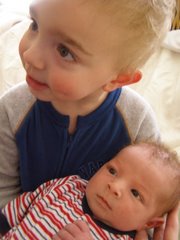
But the biggest news of all is that he is on the move! Crawling that is. The poor thing had no choice! Because we have marble floors, I never dare to leave him sitting unattended since he still occasionally flops over (not that I leave my children unattended for long periods, but I do have Evan to chase too). Therefore, if I need to turn my back, I always place him on his belly on a mat on the floor. Out of necessity he started slowly inching towards things beyond his reach. He is rapidly getting more efficient, and his movement is starting to resemble actual crawling. Whatever you want to call it, if he wants something, he can get there quickly. Just tonight we watched with delight as he chased a water bottle around our living room – I know that sounds terrible, but he was enjoying himself immensely… really.